
Process island: Surface Treatment
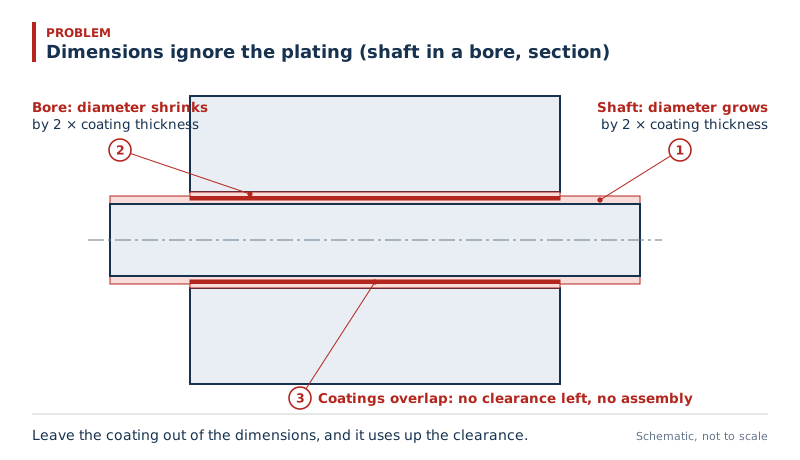
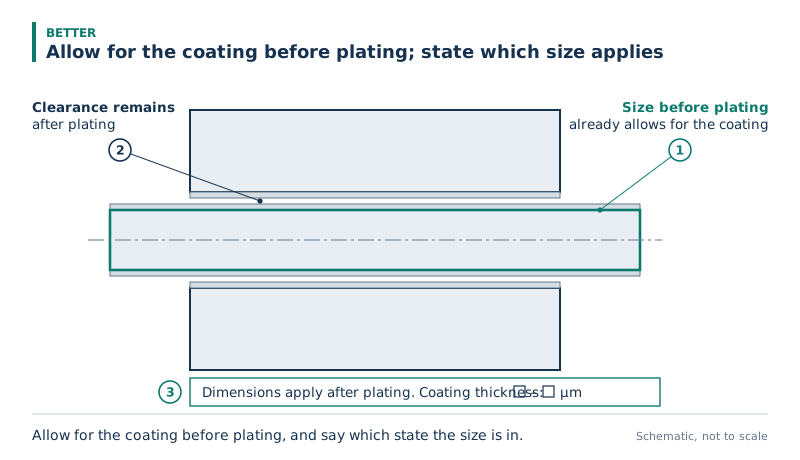
Yes, if the drawing dimensions do not include the coating. Plating is added on the outside of the surface. A shaft grows in diameter by twice the coating thickness, and a bore shrinks in diameter by twice the coating thickness. When both shaft and bore are plated, the diametral clearance is reduced by four times the coating thickness in total. There are three steps: state on the drawing whether a dimension applies before or after plating; allow for the coating in the fit dimensions before plating; and specify the coating thickness as a range, not just a minimum. Threads are affected more than plain shafts and bores and need separate treatment.
Why it happens
- Plating deposits metal on the outside of the surface, so every face grows outward by one coating thickness. A diameter has two faces, so it changes by twice the coating thickness.
- Plating thickness is not uniform. Edges, sharp corners and protruding areas usually get a thicker coating; deep holes, internal corners and recesses usually get a thinner one. Working from the average thickness alone can still leave local interference.
- When the drawing does not say whether a dimension applies before or after plating, the machining side and the design side may each read it their own way.
When this applies
- Fit dimensions on electroplated parts, such as zinc, zinc-nickel and nickel plating.
- What the allowance involves: variation in the size after plating is machining variation plus coating variation. The fit tolerance has to hold both, or the machining tolerance before plating has to be tightened.
- Threads: on a 60° thread, the pitch diameter changes by about four times the coating thickness. An external thread usually needs a tolerance position that provides an allowance (a non-zero fundamental deviation) to make room for the coating, or it is cut undersize before plating.
- Deep holes and internal threads: the coating does not reach in easily, so it is usually thinner there and protects less. Confirm with the plater.
- Electroless nickel is not deposited by current and is more uniform than electroplating. It is still added on the outside of the surface, so the allowance is worked out the same way.
- How this differs from anodizing:
- An anodic coating is converted from the aluminum itself, and part of it grows into the base material. Each surface moves outward by less than the coating thickness (see "Does anodizing change my shaft diameter?" and "How tight a tolerance can I hold after anodizing?").
- A plated coating is all on the outside of the surface, so each surface moves outward by the full coating thickness.
- Anodizing is used on aluminum and a few other metals. Plating is mostly used on steel parts, and brings the thick-edge, thin-recess effect described above.
Basis for the numbers
- Change in diameter = 2 × coating thickness: geometry.
- Pitch diameter of a 60° thread changes by about four times the coating thickness: geometry (2 × coating thickness ÷ sin 30°).
- Relationship between electroplated coatings on threaded parts and thread tolerance positions: ISO 4042.
- Worked example: with a coating thickness of 8 µm, the shaft diameter grows by 16 µm, the bore diameter shrinks by 16 µm, and the pitch diameter of a 60° thread changes by about 32 µm. 8 µm is an illustrative example value.
- "Thicker at edges, thinner in recesses" and "part of an anodic coating grows into the base material" are general experience. The proportions vary with the process and the finisher.
Other ways engineers ask this
- My thread won't go in after plating. Why? The coating changes the pitch diameter of a 60° thread by about four times its thickness, so 8 µm of coating means about 32 µm. If the thread tolerance does not leave that much, the thread will not assemble.
- Is the dimension on the drawing before or after plating? Unless stated, it is normally read as the finished size, that is, after plating. For fit dimensions, state it on the drawing and give the coating thickness range.
- How do plating and anodizing differ in their effect on size? A plated coating is all on the outside of the surface, so a diameter grows by twice the coating thickness. Part of an anodic coating grows into the base material, so a diameter grows by less than twice the coating thickness.
AnvilQ gives design engineers manufacturability feedback on machined parts, so questions like this come up before the drawing goes out for quotation.
Get started