
Process island: Materials
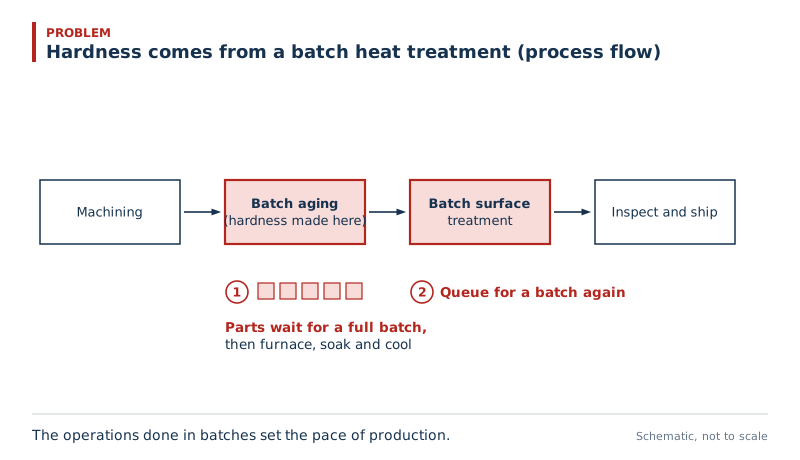
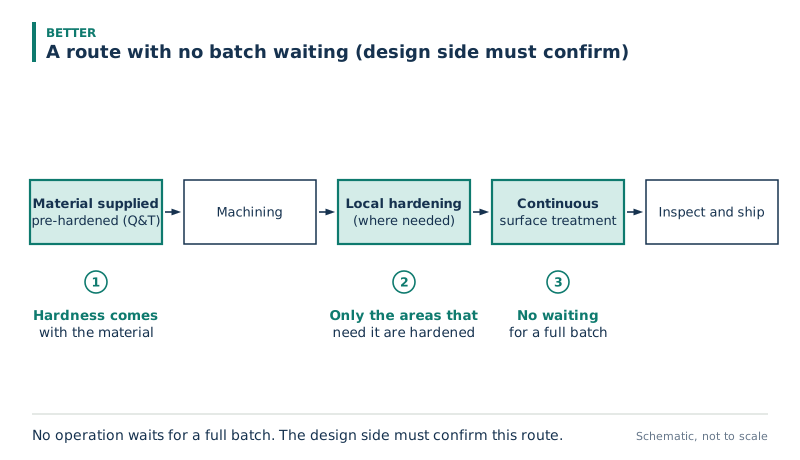
Usually not because cutting is slow. The hardness has to come from a heat treatment that is done in batches, such as the aging of a precipitation-hardening stainless steel. Parts first have to be collected into a batch, then go into the furnace, soak, cool and be checked for hardness, and this operation often goes out to an external heat treater. The furnace capacity and the cycle of each batch are fixed, and that limits the pace of production. If a surface treatment done in batches follows, the parts queue once more. Check first how much hardness the function really needs and where. There is often a route that does not wait for full batches.
Why it happens
- Machining can run part after part without stopping. Batch heat treatment waits until a batch is complete, and the cycle of each batch is largely fixed by the process.
- Samples are few and go through in one furnace load, so the limit does not show. In production every batch has to queue, and the operations before and after have to follow its pace.
- A drawing that specifies the material and its heat-treated condition specifies this process route with it. The shop has no room to adjust.
When this applies
- Parts in production quantities whose drawing specifies a precipitation-hardening stainless steel, or another material that only reaches its hardness through a batch heat treatment.
- What changing the material involves:
- A quenched and tempered alloy steel does not resist corrosion as a stainless steel does. It needs a separate protective surface treatment, and fit dimensions have to allow for the coating (see "Will plating change my fit dimensions?").
- There is an upper limit to the hardness that can be machined directly in the quenched and tempered condition. Above that, local hardening or a full heat treatment is still needed.
- Strength and toughness differ from the original design, and the design side has to confirm them again.
- When not to change: if corrosion resistance, non-magnetic behavior or high-temperature performance is the reason the original material was chosen, keep the design and include the batch operations in the production plan.
- At low quantities the batch limit hardly shows, and a change may not be needed.
Basis for the numbers
- No specific values and no durations are given here.
- "Batch heat treatment limits the pace of production" and "material supplied quenched and tempered can be machined directly" are general experience. They vary with the material, the hardness level and the heat treater.
Other ways engineers ask this
- The samples came quickly. Why can't production be scheduled as fast? Samples go through in one furnace load. In production, every batch has to be collected, go through the furnace, and wait for cooling and inspection. The pace is set by that batch operation, not by cutting.
- What material can I change to, to shorten the process for a high-hardness part? A common direction is an alloy steel supplied quenched and tempered, with local hardening where high hardness is needed. Corrosion resistance and strength change, so the design side has to confirm it and add a protective surface treatment.
- Can I specify hardness only locally? Yes, and it is the better way. When only one area needs the hardness, mark the area and the hardness on the drawing, and the process can use local hardening.
AnvilQ gives design engineers manufacturability feedback on machined parts, so questions like this come up before the drawing goes out for quotation.
Get started