
Process island: CNC Milling
In many cases yes, and it is worth evaluating first. In a multi-part assembly, the functional features sit on different parts. Their relative position passes through every part's tolerances, plus the clearance or position tolerance at every joint. As one part, those features are on the same piece and machined from the same datum, so the only error left is the accuracy of the machining itself. The trade-off is more material to remove, the cutter has to reach every area, and the part can no longer be taken apart. Sometimes the shape has to be simplified before it can be made as one part.
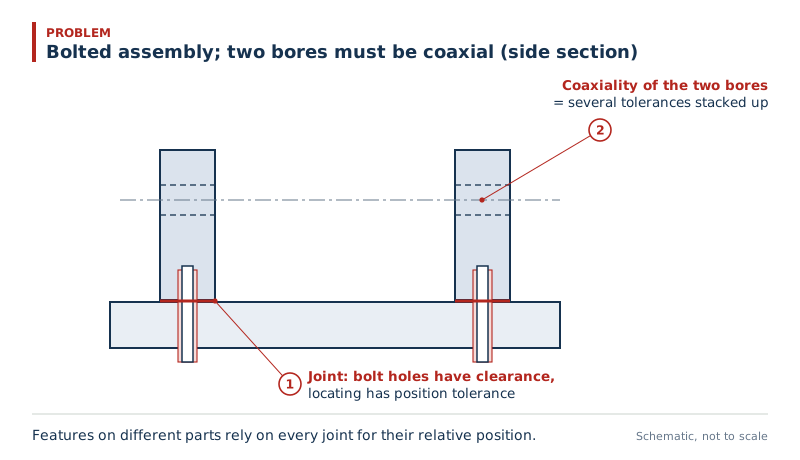
Why it happens
- Between the two bores there are three parts and two joints. Each part has its own machining tolerances, and each joint has the clearance of its bolt holes or the position tolerance of its locating elements.
- In the worst case these tolerances add up directly. To reduce the stack-up, every one of them has to be tightened, which adds machining and inspection work.
- Another approach is to machine both bores together after assembly. But then the parts are no longer interchangeable, and the set has to be replaced as a whole in service.
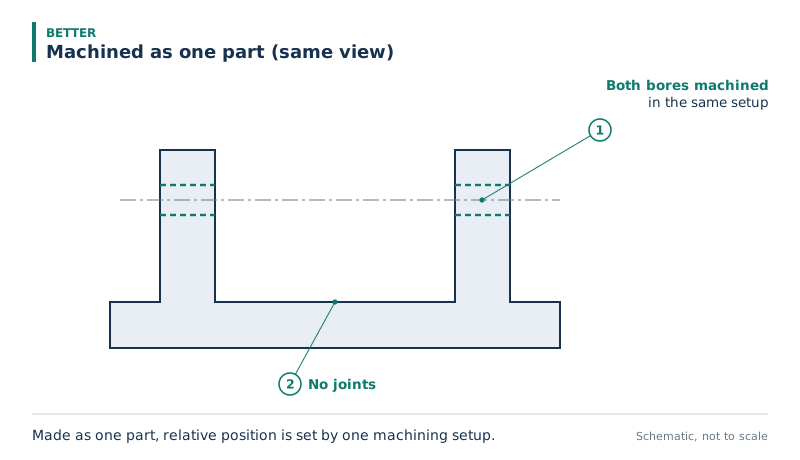
When this applies
Cases where staying with several parts makes sense:
- Too much material to remove: a one-piece part is cut from a solid block, and a deep slot or a large cavity removes most of it. Consider a forged or cast blank, or stay with several parts.
- The cutter cannot reach: deep, narrow internal cavities and sharp internal corners may be impossible to machine in one piece, or need a change of shape.
- The assembly has to come apart, or areas need different materials: for example, a wear part that gets replaced, or one area that must be hard and another light.
- If you stay with several parts: put the most critical group of features on the same part. At the other joints, set position with a defined locating face or locating element, not with the bolt holes.
For the same question on rotating parts, see "Should the hub and gear be one piece or two?"
Basis for the numbers
- No specific values are given here.
- "In the worst case the tolerances add up directly" is the basic method of tolerance stack-up (worst-case analysis).
- "Only machining accuracy is left" assumes the related features are finished in the same setup. If the part has to be turned over, the locating error of the second setup is added.
Other ways engineers ask this
- Two holes don't line up after assembly. What can I do? First count how many parts and joints lie between the two holes. Putting both holes on the same part and machining them in one setup is the most effective. If that is not possible, set position with a locating face or locating element, not with the bolt holes.
- Will tightening every part's tolerance fix the stack-up? It reduces it, but only if every item is tightened, and the clearance at the joints does not go away. When there are many items, changing the structure usually works better than tightening tolerances.
- What are the limits of machining as one part? A lot of material to remove, the cutter has to reach every area, and the part cannot be taken apart. It may not suit deep, narrow cavities or areas that need different materials.
AnvilQ gives design engineers manufacturability feedback on machined parts, so questions like this come up before the drawing goes out for quotation.
Get started