
Process island: Heat Treatment
Heat-treatment distortion cannot be eliminated, only managed. Two approaches are common. When the distortion is stable and about the same in every batch, compensate for it in the machined size before heat treatment, so the part lands inside the tolerance afterwards. When the distortion is not stable, or the tolerance is smaller than the variation in distortion, leave stock before heat treatment and finish-machine those few critical dimensions afterwards. Both approaches need a trial batch first to measure the actual distortion, and the material and heat-treatment conditions have to stay fixed from then on.
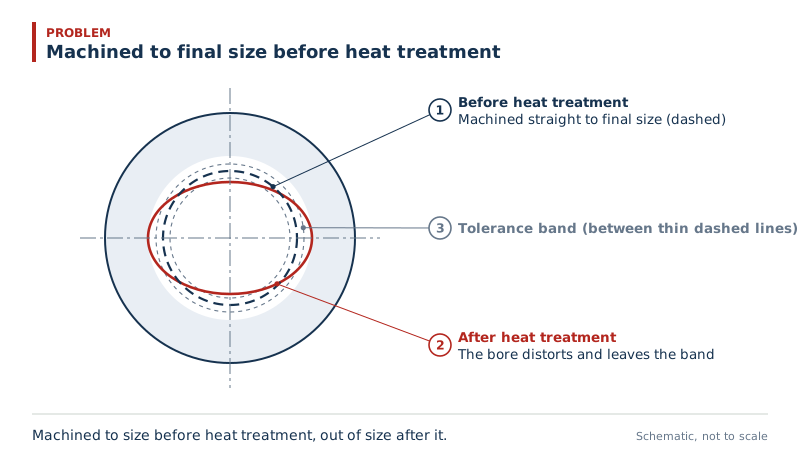
Why it happens
- During heating and cooling, temperature and microstructure change at different rates across the part. Internal stress is released, and both size and shape change.
- The direction and amount of distortion depend on the part shape, the material lot, the heat-treatment method and how the parts are loaded in the furnace. Under the same conditions it usually repeats; change a condition and it changes.
- If the drawing does not say that a dimension is required after heat treatment, the shop may machine it to final size beforehand.
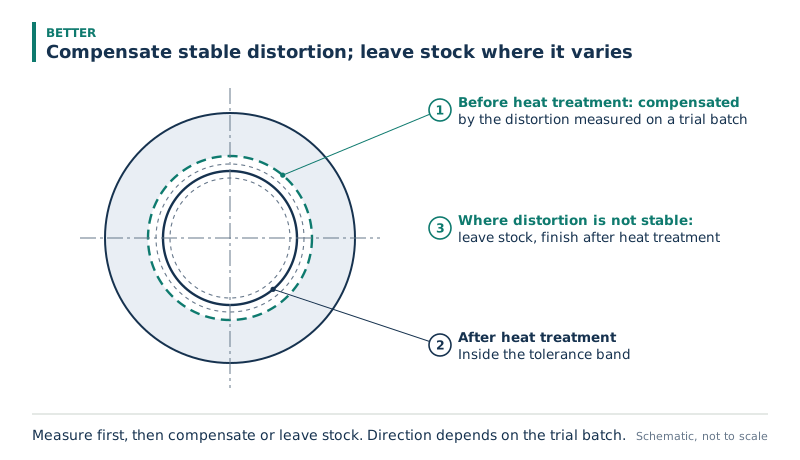
When this applies
- Steel parts that are quenched, quenched and tempered, carburized or locally hardened, including gears, shafts and hubs.
- Compensation needs stable distortion. After a change of material lot, heat treater or furnace loading, the compensation usually has to be confirmed again. That is the trade-off of this approach: a trial batch up front, and process conditions that cannot be changed freely afterwards.
- Leaving stock and finishing afterwards adds an operation after hardening, such as grinding or hard turning. Use it only on the dimensions that really need it.
- Reducing distortion from the design side: keep the shape as symmetrical as possible, keep wall thickness even and avoid sharp corners. Where hardness is only needed locally, use local hardening; overall distortion is usually smaller.
- On the drawing, state that critical dimensions apply after heat treatment.
Basis for the numbers
- No specific values are given here. Distortion depends on part shape, material and heat-treatment conditions, and has to be measured on a trial batch.
- "Distortion usually repeats under the same conditions" and "local hardening usually distorts the part less overall" are general experience.
Other ways engineers ask this
- Can heat-treatment distortion be avoided? Not completely, but it can be reduced and controlled. A symmetrical shape, even wall thickness and hardening only locally usually give less distortion.
- How much stock should I leave before heat treatment? There is no fixed number. Measure the actual distortion on a trial batch. The stock has to be larger than the largest distortion, plus what finish machining needs.
- Are the dimensions on the drawing before or after heat treatment? Unless stated, they are normally read as finished dimensions, that is, after heat treatment. To avoid misunderstanding, say so on the critical dimensions.
AnvilQ gives design engineers manufacturability feedback on machined parts, so questions like this come up before the drawing goes out for quotation.
Get started