
Process island: Forging & Casting
Not for functional dimensions and geometric tolerances. A cast surface already varies in size, has draft and is uneven, so every geometric tolerance referenced to it drifts with it, and measurements are hard to repeat. A better approach separates two jobs:
- Use the cast surface only to locate the first machining operation, with datum targets that define exact contact points.
- Machine a datum surface first, then reference every functional feature to that machined datum.
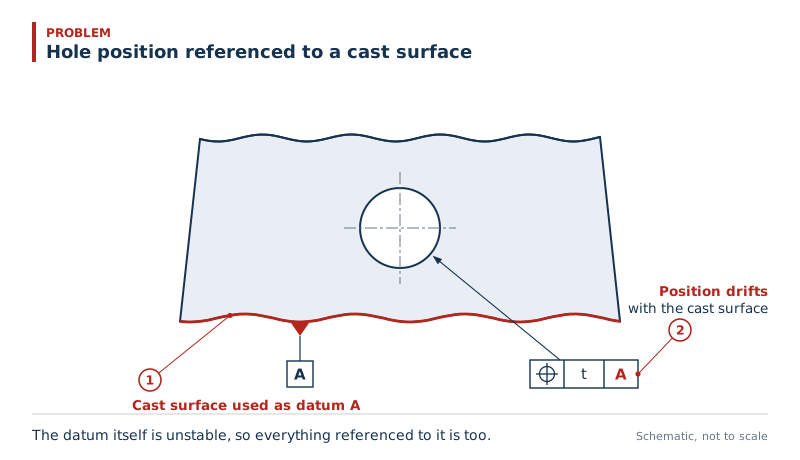
Why it happens
- Casting tolerances are much larger than machining tolerances, and draft and surface irregularity add to that. The datum itself is unstable.
- Each time the part is clamped, it touches the cast surface at different points. Measuring the same part twice can give two different results.
- Every geometric tolerance referenced to that datum inherits the cast surface's variation. This is often why a correctly machined part fails inspection.
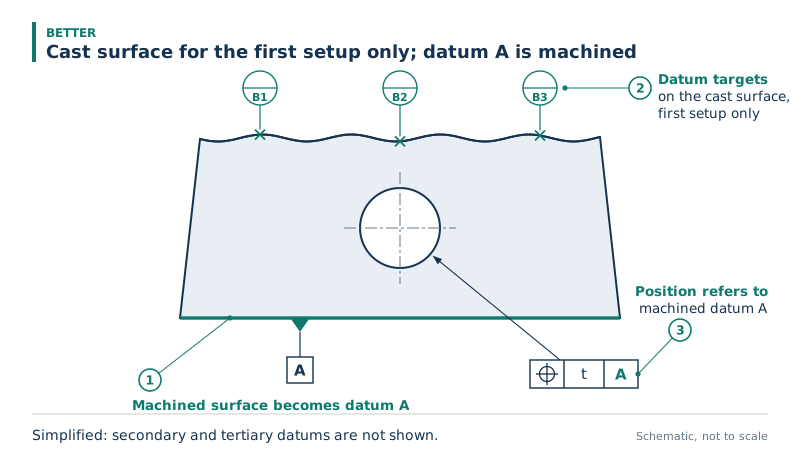
When this applies
- Investment castings, aluminum castings and other castings that are machined afterwards.
- Exception: a casting with no machining at all can only use cast surfaces as datums. In that case, define the contact points with datum targets and open up the referenced geometric tolerances to suit the casting tolerance grade.
- Forgings: the same reasoning applies to unmachined forged surfaces.
Basis for the numbers
- Casting dimensional tolerance grades (DCTG): ISO 8062-3.
- Datum target notation: ISO 5459 and ASME Y14.5.
- No specific values are given here.
Other ways engineers ask this
- Which surface should be the datum on a casting? A surface you machine first. Cast surfaces only locate that first operation.
- Why do position measurements on my casting keep changing? If the position refers to a cast datum, the part contacts the datum at different points each time it is set up.
- How should I locate a casting for the first machining operation? On datum targets on the cast surface, so every part and every setup touches the same points.
AnvilQ gives design engineers manufacturability feedback on machined parts, so questions like this come up before the drawing goes out for quotation.
Get started