
Process island: CNC Milling
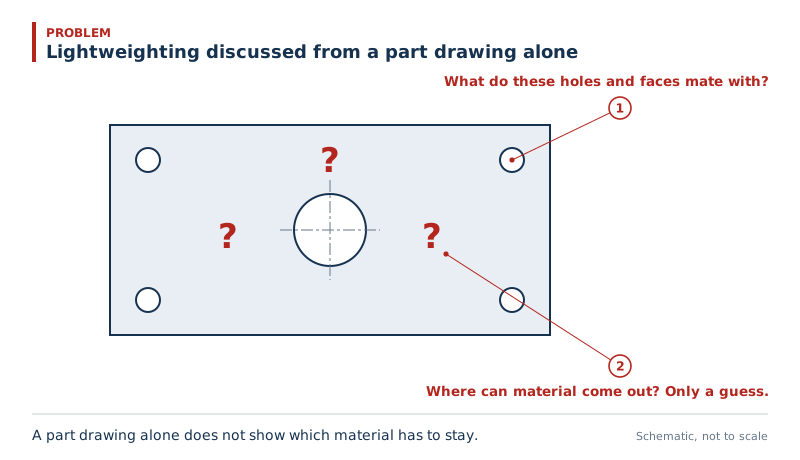
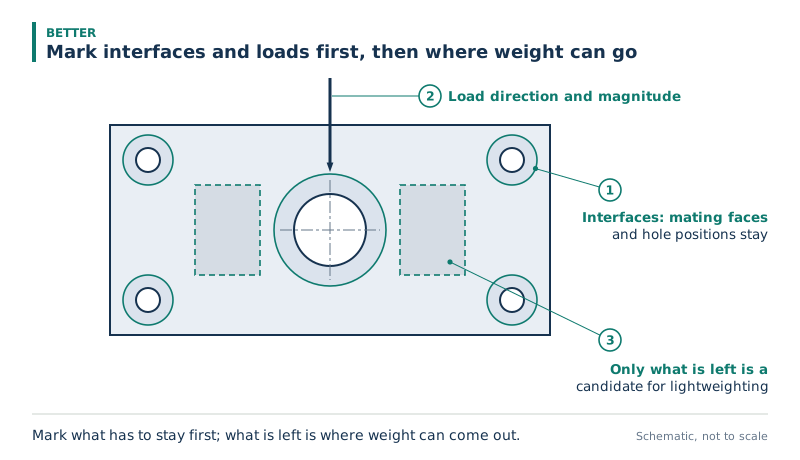
At least three things. First, mating parts and interfaces: which faces and holes fit other parts and cannot move. Second, loads: the direction and size of the forces, and the stiffness required. Third, constraints: material, surface treatment and the minimum wall thickness you can accept. A part drawing alone does not show which material carries load or which faces have a fit. Any lightweighting suggestion made from it is a guess, and may cut away a load path or a mating face.
Why it happens
- A part drawing describes shape and size. It does not describe the part's role in the assembly: what mounts on it, where forces come in and where they go out.
- What the machining side can judge is where the part is easy to machine, not where material can be taken away. The two are often not the same place.
- With lightweighting done without a basis, the risk stays with the design side. Too little stiffness, a distorted mating face or a weak mounting point often only shows up at assembly or test.
When this applies
- Machined structural parts, housings and brackets.
- What lightweighting involves:
- Pockets and thin walls add machining time.
- Walls that are too thin tend to vibrate and deflect during machining, so size and flatness are harder to hold.
- Stiffness goes down. By how much has to be evaluated by the design side from the loads.
- What the machining side can contribute, once interfaces and loads are clear: the pocket shape, internal corner radii and wall thickness that make the lightweighted areas easy to machine.
- The conclusion on strength belongs to the design side. The machining side does not make that judgment for you.
Basis for the numbers
- No specific values are given here.
- Minimum wall thickness depends on the material, the part size and the machining method. There is no general figure.
Other ways engineers ask this
- Can I ask the machine shop where my part can lose weight? Yes, but provide the interface and load information first. With it, the machining side can suggest which lightweighting shapes are easy to machine. Without it, a suggestion can only be a guess.
- Will lightweighting pockets affect strength? They reduce stiffness and strength. How much depends on whether the removed material is in a load path, and the design side has to evaluate that from the loads.
- How does lightweighting affect machining? Machining time usually goes up. Walls that are too thin tend to vibrate and deflect during machining, and size is harder to hold.
AnvilQ gives design engineers manufacturability feedback on machined parts, so questions like this come up before the drawing goes out for quotation.
Get started