
Process island: CNC Turning
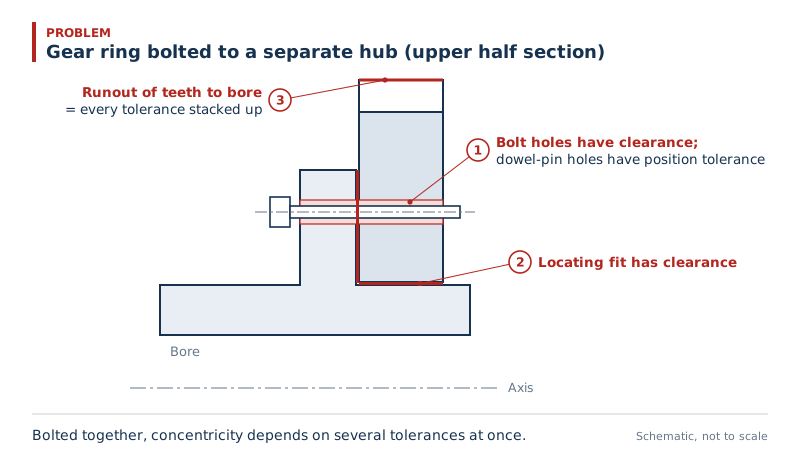
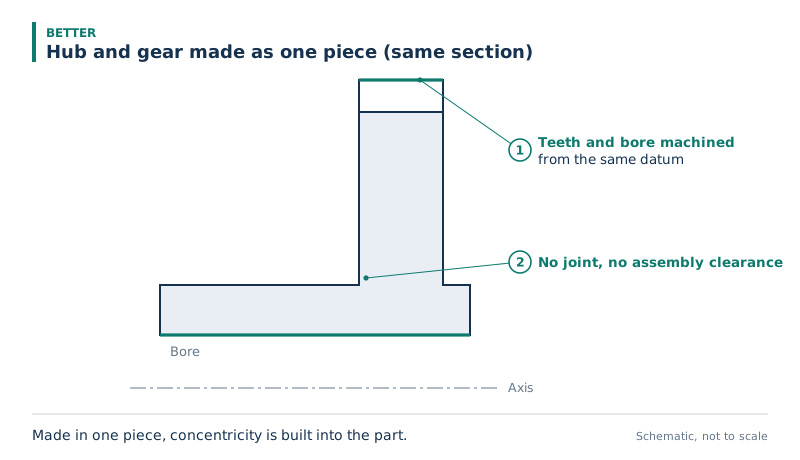
Unless something forces you to split them, make them one piece. In a bolted assembly, the concentricity of the teeth to the bore depends on the joint face, the dowel pins and the bolt holes. Each has a tolerance, some have clearance as well, and they add up to runout. In a one-piece part, the teeth and the bore are machined from the same datum, so concentricity comes from the structure itself. With concentricity stable, the tooth accuracy requirement can often be relaxed too. The trade-off is less freedom in material, heat treatment and later replacement, so first check that those conditions allow it.
Why it happens
- Each of the two parts has its own machining tolerances. Add the clearance at the locating fit and the bolt holes and the position tolerance of the dowel-pin holes, and all of it accumulates in the runout of the teeth to the bore.
- The only ways to reduce the stack-up are to tighten every one of those tolerances, or to machine the teeth after assembly. Both add operations.
- When runout is unstable, the design side often responds by raising the tooth accuracy requirement, for example by specifying grinding. But the root of the problem is the structure, not the tooth flanks.
When this applies
Cases where staying with two parts makes sense:
- The two areas need different materials, for example a light hub and hard teeth. A one-piece part has one material, and the tooth hardness then comes from local hardening such as induction hardening.
- The gear is a wear part that needs to be replaced on its own.
- A large difference in size: when the gear is much larger in diameter than the hub, machining from one piece removes a lot of material. Evaluate a forged blank, or stay with two parts.
- If you stay with two parts: let one locating fit take care of concentricity and let the bolts only clamp. Don't use the bolt holes for location.
Basis for the numbers
- No specific values are given here.
- "Tooth accuracy can be relaxed once the part is one piece" is general experience. How far depends on speed, load and noise requirements.
Other ways engineers ask this
- How do I ensure concentricity when a gear is bolted to a hub? With one locating fit, not with the bolts. Even then, the fit clearance and each part's own tolerances remain. For something more stable, make it one piece.
- Why can't I get the runout down on a gear assembled with screws and dowel pins? Because the runout is the stack-up of the locating fit, the dowel-pin hole positions, the bolt-hole clearance and the tolerances of both parts. Tightening one of them alone does little.
- What are the drawbacks of making the gear and hub one piece? There is only one material, and the gear cannot be replaced on its own. When the two diameters differ a lot, there is also more material to remove.
AnvilQ gives design engineers manufacturability feedback on machined parts, so questions like this come up before the drawing goes out for quotation.
Get started