
Process island: CNC Turning
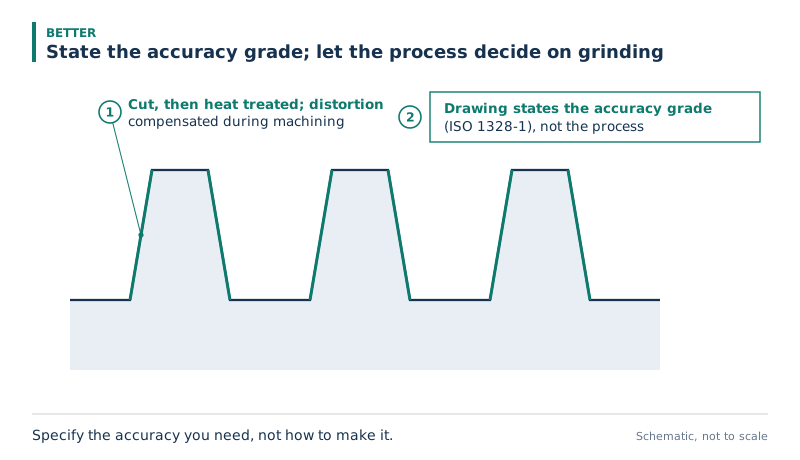
For most general industrial uses, no. The main benefits of grinding are quiet running at high speed and the removal of tooth distortion from hardening. For a gear that runs at moderate speed with no noise requirement, cutting the teeth, heat treating and compensating for distortion during machining is usually enough. Specifying grinding adds operations and makes production harder to schedule. A better approach is to state the accuracy grade you need on the drawing and leave the decision on grinding to the process.
Why it happens
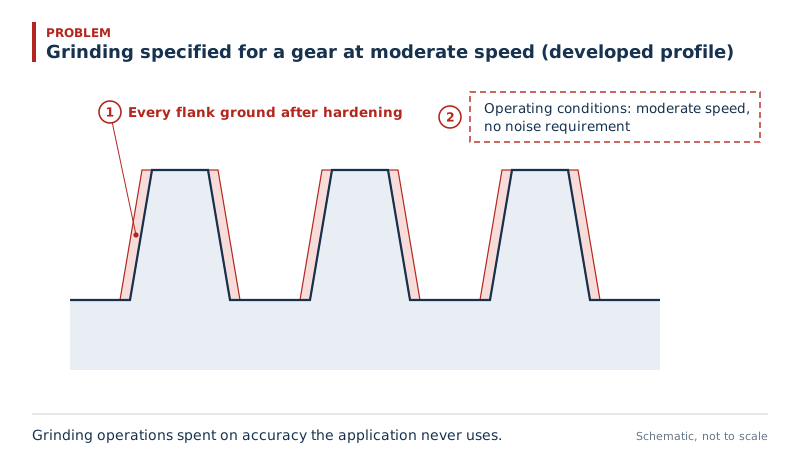
- Grinding is a separate finishing operation after hardening. It needs dedicated machines and adds cycle time, which often makes it a bottleneck in production scheduling.
- What it buys is a more accurate tooth form and a better flank surface, which mainly show up as lower noise and vibration at high speed. At low speed, the difference is not noticeable in use.
- Writing "ground" on the drawing fixes the process. Even if cutting plus heat treatment already reaches the accuracy needed, the grinding cannot be dropped.
When this applies
Cases where grinding is needed, or should be evaluated separately:
- High speed, or a defined noise or vibration requirement.
- A high accuracy grade that cutting plus heat treatment cannot reach.
- Hardening of the whole gear, such as carburizing and quenching, when the distortion is too large or too variable to compensate in advance.
- Check concentricity first: when the gear is not stably concentric to its bore, runout cancels out what grinding gains. Fix the structure first (see "Should the hub and gear be one piece or two?").
Basis for the numbers
- Definition of gear accuracy grades: ISO 1328-1.
- "Most general industrial uses do not need grinding" is general experience. Where the line falls for speed and noise depends on the application, and no specific values are given here.
Other ways engineers ask this
- What is the difference between a ground and an unground gear? A ground gear has a more accurate tooth form and a better flank surface. The difference is mainly in noise and vibration at high speed, and the trade-off is one more finishing operation after hardening.
- Does a gear always have to be ground after heat treatment? No. If distortion can be compensated during machining and the accuracy reaches the grade on the drawing, it doesn't.
- Should I specify grinding on the drawing? Better to state the accuracy grade and not the process. Specify grinding only when you are sure the grade or the flank requirement can only be reached by grinding.
AnvilQ gives design engineers manufacturability feedback on machined parts, so questions like this come up before the drawing goes out for quotation.
Get started