
Process island: Forging & Casting
Treat cast surfaces and machined surfaces separately. For dimensions on cast surfaces, state a general tolerance using the casting tolerance grade (DCTG) from ISO 8062-3. The grade depends on the casting process, the alloy and the size; confirm it with the foundry and write it on the drawing. Dimensions that need a tight tolerance are finished by machining, with the machining allowance stated. Talking in grades gives both sides a common standard to refer to, instead of arguing over each dimension.
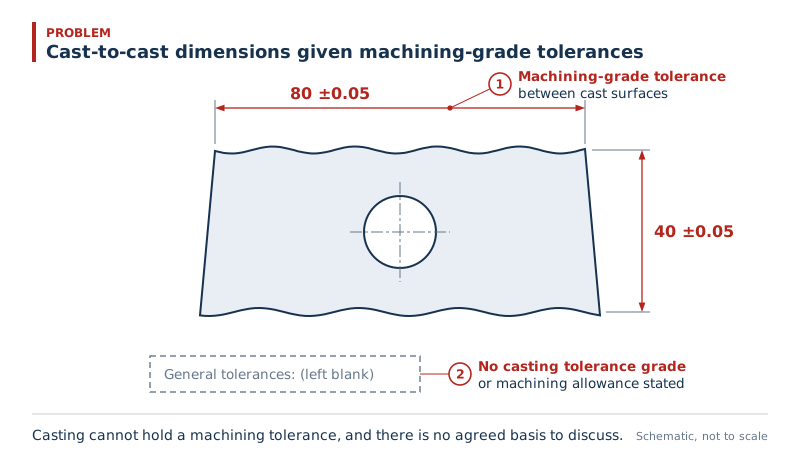
Why it happens
- Dimensional variation in casting comes from the tooling, shrinkage and draft, and is much larger than in machining. A machining-grade tolerance on cast surfaces amounts to asking for machining all over.
- Without a general tolerance note, each side has its own reading of what standard applies to untoleranced dimensions.
- Without a stated machining allowance, a machined face may have too little stock and keep patches of cast skin, or too much and waste material and machining time.
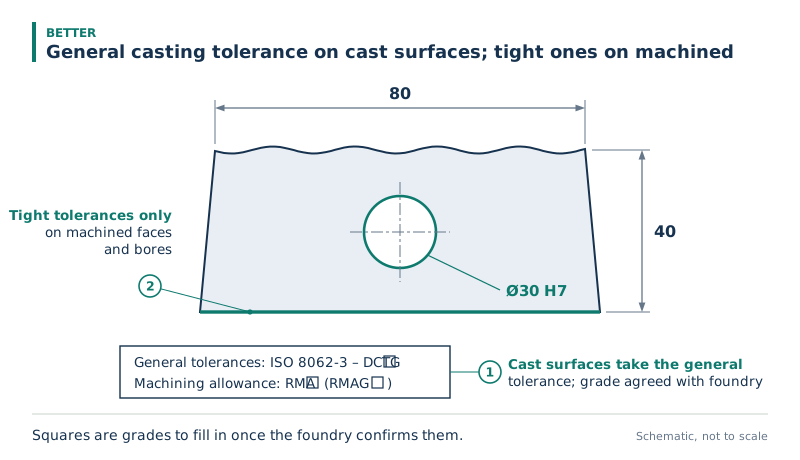
When this applies
- Sand castings, investment castings, die castings and other castings.
- Choosing the grade: the achievable grade differs by process, alloy and size. Use the grade the foundry confirms. Don't simply specify the tightest one.
- A single dimension that needs to be tighter can be toleranced individually, but confirm with the foundry that it can be held. If not, machine it.
- Geometrical tolerances on castings have their own grades (GCTG). This topic covers dimensional tolerances only.
- Datums: a cast surface should not be a functional datum (see "Can I use a cast surface as a datum?").
Basis for the numbers
- Definitions and drawing indication of the casting tolerance grade DCTG, the machining allowance grade RMAG and the geometrical tolerance grade GCTG: ISO 8062-3.
- 80, 40 and Ø30 H7 in the figures are illustrative examples; ±0.05 only stands for "a machining-grade tolerance".
- No tolerance values for any grade are quoted here.
Other ways engineers ask this
- What dimensional tolerance can a casting normally hold? It depends on the casting process, the alloy and the size, so there is no single number. Asking the foundry for an ISO 8062-3 DCTG grade is more reliable than asking for a number.
- What does DCTG on a drawing mean? It is the casting dimensional tolerance grade defined in ISO 8062-3. The higher the number, the wider the tolerance.
- How much machining allowance should a casting have? It follows from the machining allowance grade (RMAG) in ISO 8062-3 and the size of the casting. The foundry and the machining side confirm it, and it goes on the drawing.
AnvilQ gives design engineers manufacturability feedback on machined parts, so questions like this come up before the drawing goes out for quotation.
Get started