
Process island: CNC Turning
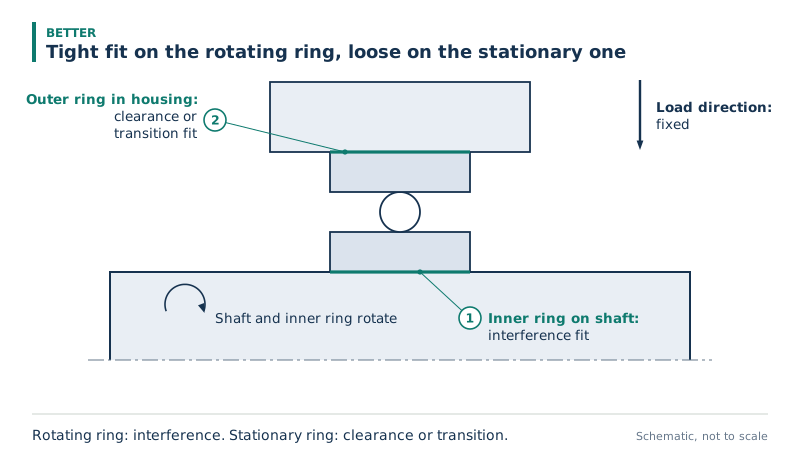
It depends on which ring rotates relative to the direction of the load.
- The ring that rotates relative to the load needs an interference fit. The most common case: the shaft turns the inner ring and the load direction stays fixed.
- The ring that is stationary relative to the load can take a clearance or transition fit. That makes assembly easier and lets the bearing float axially.
Tighter is not automatically better.
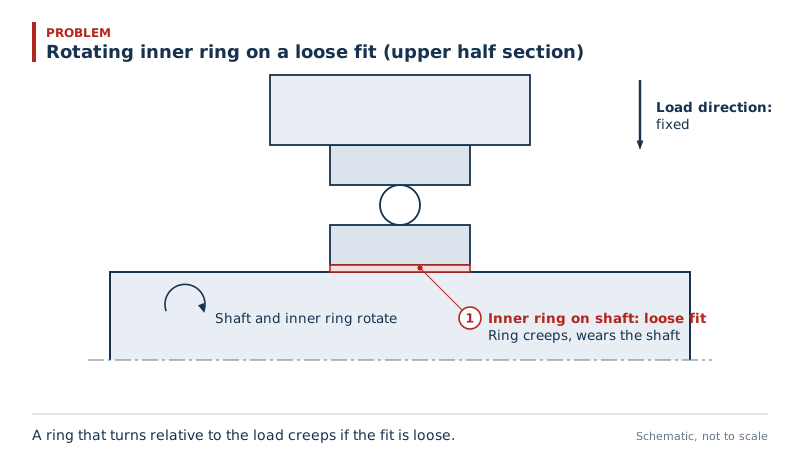
Why it happens
- If a ring that rotates relative to the load is fitted too loosely, it slowly slides on its seat. This is called creep, and it causes wear and heat and can damage the shaft.
- If the fit is too tight, it takes up the bearing's internal clearance. That causes heat, shortens bearing life and makes assembly harder.
- The bearing bore tolerance lies entirely below nominal size. The same shaft tolerance class therefore gives a tighter fit with a bearing than with an ordinary hole.
When this applies
- Rotating outer ring, such as idler pulleys and wheel hubs, where the outer ring turns with the wheel and the shaft stays still: the rule reverses. The outer ring gets the tight fit and the inner ring the loose one.
- Load direction not fixed, for example with an unbalanced load: consider interference fits on both rings.
- Plastic or thin-walled aluminum housings: deformation and thermal expansion change the actual fit, so evaluate it separately.
- The exact tolerance class depends on the load and on the bearing maker's recommended fits table.
Basis for the numbers
- Bearing bore tolerance below nominal size: ISO 492.
- Values for tolerance classes: ISO 286-2.
- For light to normal loads with a rotating inner ring, j6 or k5 on the shaft and H7 in the housing are common starting points: general experience. Make the final choice from the bearing maker's catalog.
Other ways engineers ask this
- Should I use k5 or h6 for a bearing on a shaft? For a rotating inner ring under a fixed load, a class that gives interference with the bearing bore, such as j6 or k5, is the usual starting point. Confirm it in the bearing maker's fits table.
- How tight should a bearing housing bore be? If the outer ring is stationary relative to the load, a clearance or transition fit such as H7 is common.
- The inner ring is spinning on my shaft and leaving marks. Is it the fit? Very likely. That is creep, the typical sign of a loose fit on a ring that rotates relative to the load.
AnvilQ gives design engineers manufacturability feedback on machined parts, so questions like this come up before the drawing goes out for quotation.
Get started