
Process island: CNC Turning
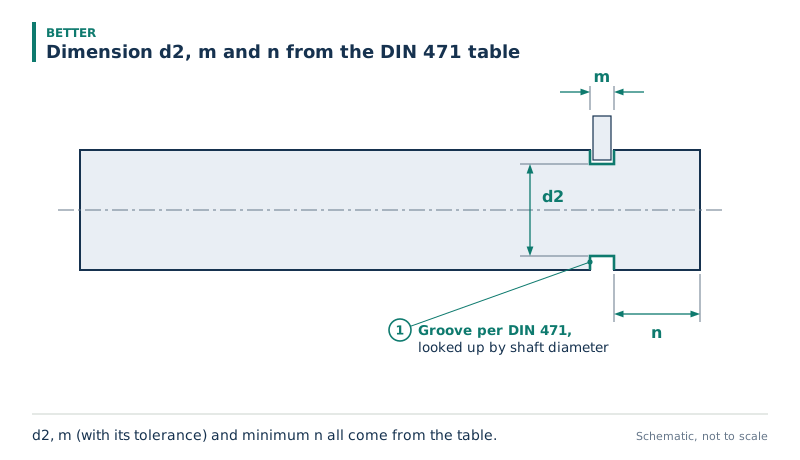
Don't work it out yourself. Look up your shaft diameter in DIN 471 and put three values on the drawing: the groove diameter d2, the groove width m with its tabulated tolerance, and the minimum distance n from the groove to the end of the shaft. The ring's axial load rating and secure seating are based on the standard groove. Once you change the groove dimensions, that rating no longer applies.
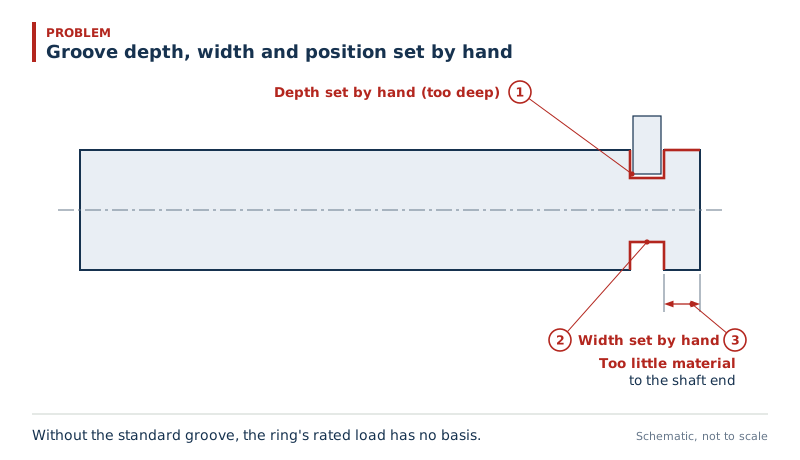
Why it happens
- A groove that is too shallow does not hold the ring, and the ring can pop out under axial load. A groove that is too deep weakens the shaft section and raises stress concentration.
- With too little material between the groove and the shaft end, that material can deform or shear under axial load.
- Non-standard dimensions mean the shop cannot use standard grooving tools and gauges, and inspection has no common reference.
When this applies
- External retaining rings on shafts (DIN 471 series). Internal rings in bores follow DIN 472.
- For high axial loads or high speeds, check the load capacity of both the ring and the groove in the table. If needed, use a heavy-duty ring or another way to locate the part axially.
- On coated or plated shafts, state whether the groove dimensions apply before or after treatment.
- Keep the groove bottom radius as DIN 471 specifies, and keep the groove's load-bearing edge sharp. A large radius or chamfer at that edge lets the ring ride out under axial load.
Basis for the numbers
- d2, m and its tolerance, minimum n and load capacity: DIN 471 tables, by shaft diameter.
- Groove bottom radius r: defined in DIN 471. Sharp load-bearing groove edge: general shop experience.
- No specific values are shown here.
Other ways engineers ask this
- How deep should an external circlip groove be? As deep as DIN 471 gives for your shaft diameter: dimension it with d2, not as a depth you choose.
- How do I tolerance a retaining-ring groove? Use the tolerances listed with d2 and m in DIN 471.
- My retaining ring pops out under load. Is the groove the problem? Check the groove against the table first, then check whether the axial load is within the ring and groove capacity.
AnvilQ gives design engineers manufacturability feedback on machined parts, so questions like this come up before the drawing goes out for quotation.
Get started